AI and AGI
December 16, 2025
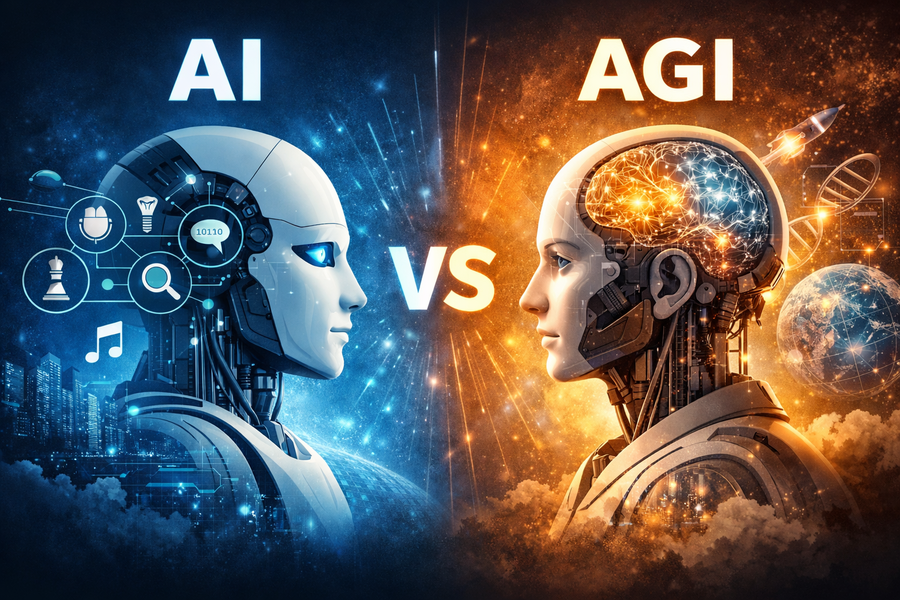
AI: powerful, but narrow
Artificial Intelligence (AI) has quietly become part of our everyday lives. From recommendation engines on Netflix and Spotify to spam filters, chatbots, image recognition, and fraud detection — most modern software products rely on some form of AI.
However, almost all AI we use today is narrow AI (also called weak AI). These systems are trained to perform one specific task extremely well:
- A model that recognizes faces cannot translate text.
- A chess engine cannot drive a car.
- A large language model can generate text but does not truly understand the world.
Narrow AI excels because it is optimized, data-driven, and constrained. This makes it incredibly valuable for businesses — but also fundamentally limited.
What is AGI?
Artificial General Intelligence (AGI) refers to a hypothetical type of AI that can understand, learn, and apply knowledge across a wide range of tasks, much like a human.
An AGI system would be able to:
- Learn new skills without task-specific retraining
- Transfer knowledge from one domain to another
- Reason, plan, and solve novel problems
- Adapt to unfamiliar situations
In short: AGI would not just execute instructions, but would be able to think, learn, and generalize.
AI vs AGI: the core difference
The difference between AI and AGI is not about power, but about scope.
- AI: Specialized, task-oriented, optimized for specific problems
- AGI: General, adaptive, capable of human-level reasoning across domains
You can think of today’s AI as a collection of brilliant specialists — while AGI would be a true generalist.
This distinction matters because scaling narrow AI does not automatically lead to AGI. Making a model bigger or faster does not guarantee general intelligence.
Why AGI matters
AGI is not just a technical milestone — it represents a potential paradigm shift.
If achieved, AGI could:
- Automate complex cognitive work
- Accelerate scientific discovery
- Redefine knowledge work and education
- Challenge existing economic and social structures
For product builders and businesses, AGI would blur the line between tools and collaborators. Software would no longer just assist users — it could actively reason alongside them.
Are we close to AGI?
This is one of the most debated questions in tech.
Recent breakthroughs — especially large language models — have made AI feel more general than ever. Models can write code, explain concepts, summarize documents, and reason to a certain extent.
Still, most experts agree:
- Current systems simulate intelligence, but lack true understanding
- They rely heavily on data patterns rather than grounded reasoning
- They struggle with long-term planning, consistency, and real-world awareness
In other words: today’s AI is impressive, but still narrow.
The product perspective
From a product and business standpoint, it is important to stay grounded.
You don’t need AGI to build valuable products.
Most successful AI-powered products today:
- Solve one clear problem
- Use AI as an enabler, not a goal
- Focus on UX, trust, and reliability
Chasing AGI is a research ambition. Building great products is about applied intelligence, not general intelligence.
Risks and responsibility
AGI also raises serious ethical and societal questions:
- Who controls a general intelligence?
- How do we align it with human values?
- What happens to jobs, power, and decision-making?
These are not problems we “fix later”. Even narrow AI already forces us to think about bias, transparency, and accountability. AGI would amplify those challenges dramatically.
Final thoughts
AI is already transforming how we build products and businesses. AGI, if it ever becomes reality, would transform everything else.
As builders, founders, and product thinkers, the key is to:
- Understand the difference between hype and capability
- Use AI pragmatically and responsibly
- Design systems that augment humans, not replace judgment
AGI may be the long-term horizon — but meaningful impact happens much earlier, with well-designed, focused AI solutions.
At Stack 83, we believe progress comes from clarity, craftsmanship, and responsible technology — not from chasing buzzwords, but from building things that actually work.