RTO vs RPO: The Difference Every CTO Must Understand
July 18, 2025
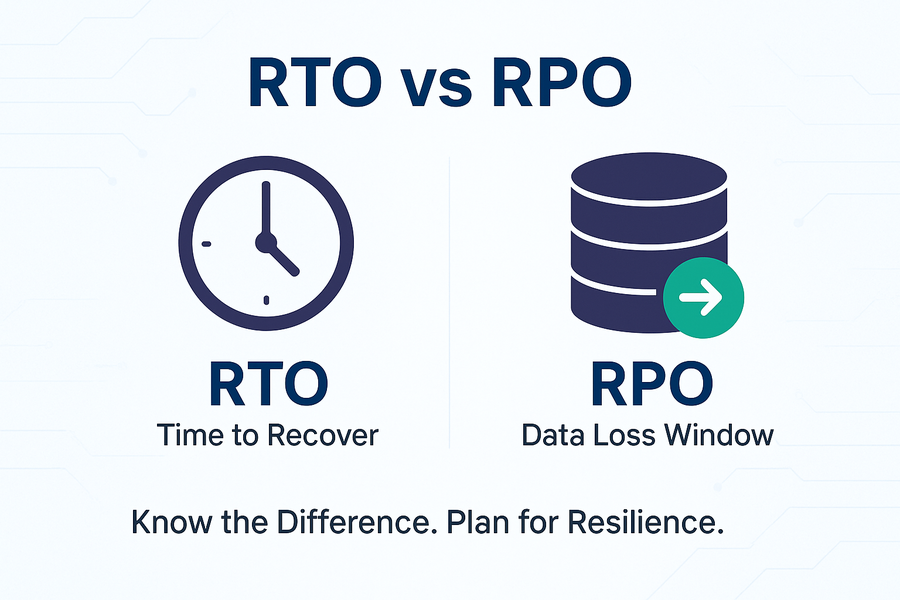
RTO vs RPO: The Difference Every CTO Must Understand
When disaster strikes—whether it’s a system crash, a cyberattack, or a cloud outage—how fast can you recover, and how much data are you willing to lose?
These questions are answered by two key metrics in disaster recovery planning: RTO (Recovery Time Objective) and RPO (Recovery Point Objective). They’re often misunderstood, but aligning your business and technical teams around these definitions is essential for building resilient systems.
What is RTO (Recovery Time Objective)?
RTO defines how much time you can afford for your systems to be offline after a failure before your business is significantly impacted.
Think of it as your maximum acceptable downtime.
Example:
If your e-commerce platform has an RTO of 1 hour, you must recover from an outage within 60 minutes to avoid major losses.
What is RPO (Recovery Point Objective)?
RPO defines how much data you can afford to lose in terms of time.
It’s about your maximum acceptable data loss from the last good backup or restore point.
Example:
If your system has an RPO of 15 minutes, your backups or replication must be frequent enough that you never lose more than 15 minutes of data in a disaster.
Key Differences Between RTO and RPO
| Metric | Definition | Focus | Unit | Question Answered |
|---|---|---|---|---|
| RTO | Max downtime | Time to recover | Hours/minutes | “How fast do we need to recover?” |
| RPO | Max data loss | Backup frequency | Hours/minutes | “How much data can we lose?” |
Why RTO and RPO Matter
Setting clear RTO and RPO targets drives decisions about:
- Infrastructure: Do you need redundant systems, failover clusters, or just cloud snapshots?
- Cost: Lower RTO/RPO usually means higher infrastructure and operational costs.
- SLAs: Aligning internal and external service level agreements.
- Incident Response: Guiding how your team reacts in crisis scenarios.
How to Define Realistic RTO and RPO
- Start with the business impact: Identify critical systems and their cost of downtime.
- Map system dependencies: Some systems may rely on upstream services with stricter RTO/RPO.
- Test disaster recovery plans: Theoretical numbers mean nothing if they’re never validated.
- Balance cost vs. risk: Instant failover may not be justifiable for every internal tool.
Final Thoughts
Whether you’re building a 99.999% uptime SaaS or managing internal tools for a medium-sized business, knowing the difference between RTO and RPO can save your company time, money, and reputation.
📌 Tip: Document these metrics for every critical system—and revisit them at least quarterly.
Bonus: Visual Analogy
Imagine you’re writing a document:
- RPO is the last time you hit Save.
- RTO is how long it takes to reopen the file and resume work if your computer crashes.
Both matter—but in different ways.
Looking to improve your incident response and uptime guarantees?
At Stack83, we help you build resilient, testable systems with real-world metrics. Let’s talk.